
More help than a blank page
When you do not know where to start, MAX can ask the next gentle question and help you turn the messy version into words.
Why MAX
Most people do not need a clinical label in the first few minutes of a hard moment. They need a private place to say the honest version, slow the loop, and leave with one useful next step.
MAX is for private, text-first reflection in everyday hard moments. It is a companion, not therapy or emergency care.

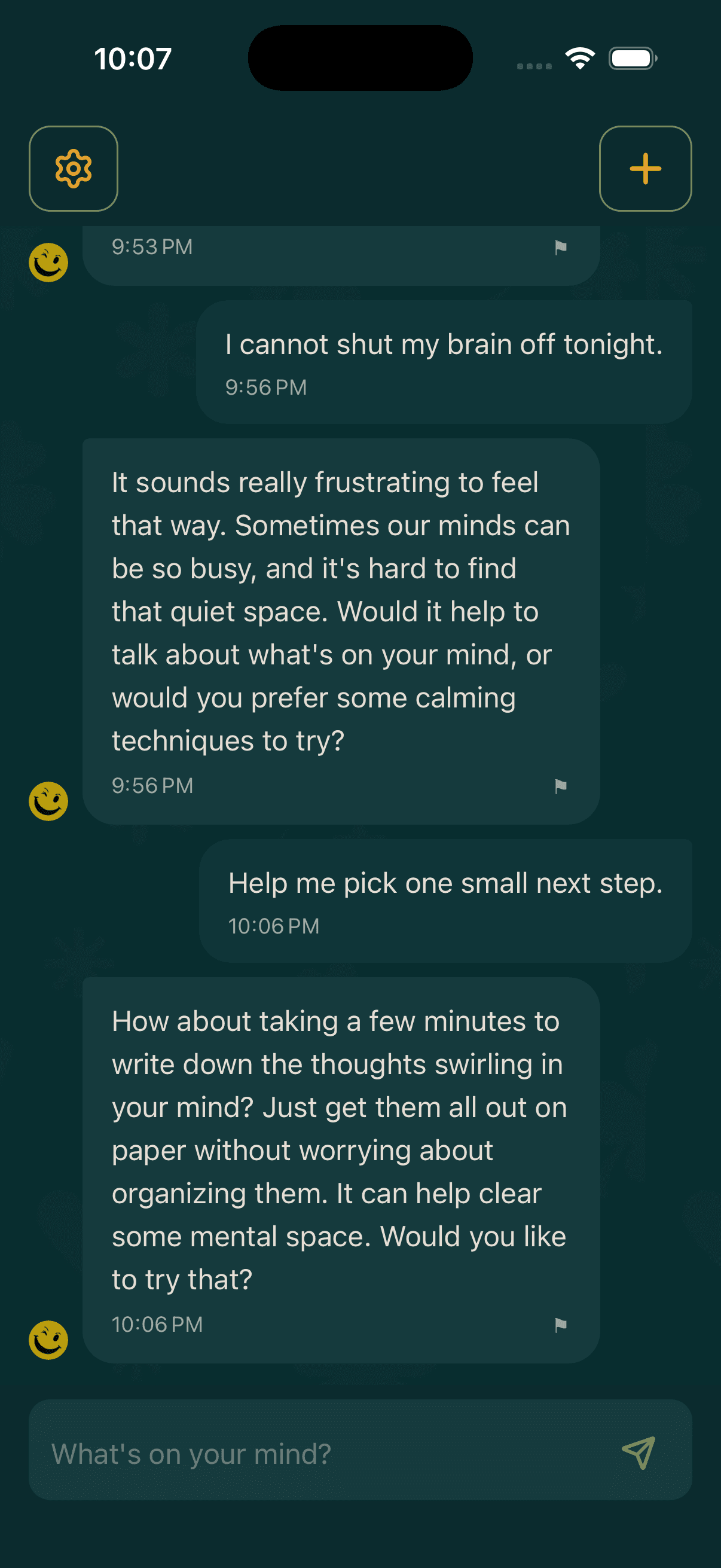
Why a companion
A blank note waits for you to organize yourself. A generic chatbot can answer almost anything, which is not always helpful when you are overwhelmed. MAX is narrower by design: emotional check-ins, continuity, and practical next-step thinking.
When you do not know where to start, MAX can ask the next gentle question and help you turn the messy version into words.
MAX is oriented around emotional context, memory, and next steps, not endless Q&A or trying to be everything at once.
MAX gives ordinary hard moments somewhere to go before they pile up into something harder to untangle later.
What makes MAX different
The difference is not a dramatic promise. It is the shape of the check-in: slower, more personal, and more focused on what helps now.
Typing can be quieter and easier to control when a thought feels too raw to say out loud.
Useful context can carry forward so the next check-in does not have to start from zero.
MAX can help notice when an assumption, replay, or all-or-nothing thought is making the moment harder.
A useful check-in should leave you with something small enough to do: a sentence, a pause, a boundary, or a next action.
What a good check-in does
MAX is most useful when it helps a difficult thought become clearer without turning the moment into a diagnosis.
Example check-in
You might start with
“I keep replaying that conversation, and I can't tell if I messed everything up.”
MAX helps you separate
What happened, what you are assuming, what you need right now, and one next sentence or action.
Step 1
Start with what you actually feel, even if it is incomplete, repetitive, or not ready to send to anyone.
Step 2
Separate what happened from what you are afraid it means, so the thought is easier to look at.
Step 3
Bring forward useful patterns, preferences, and follow-ups from earlier check-ins when they matter.
Step 4
End with a next sentence or action that fits the moment instead of pretending everything is solved.
Clear boundaries